Tuesday, July 7, 2009

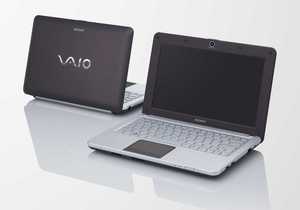
Sony's first netbook


After all the noise Sony made about avoiding the term "netbook" with the release of its Vaio P ultraportable, and the statements Senior Vice President Mike Abary made about the Eee PC before that, it was beginning to look like Sony was never going to release a device in the netbook/mini-note form factor. But that has changed.

Today, Sony officially launched its first netbook. The 10.1-inch Windows XP-based Vaio W runs on a 1.66 GHz Intel Atom N280, has 1 GB of RAM, and a 160 GB SATA HDD. It's equipped with 802.11b/g/n, Bluetooth, a built-in Webcam, and offers 1366 x 768 screen resolution -- higher-than-usual for netbook screens.Unlike many other companies who are aligning with mobile broadband chipmakers and network operators to make their products truly mobile, Sony says the Vaio W is for use in the home as a secondary or maybe even tertiary computer.

To retain the traditional Vaio emphasis on multimedia, the W comes with Vaio Media Plus streaming multimedia software, which lets the netbook interact with DLNA-compatible household devices, such as a PC, PlayStation 3, or HDTV. But since it is a netbook after all, it is being touted less as a media portal, and more as a creature comfort.

The company paints the device as an Internet companion suitable only for the most superficial tasks. Sony's introduction of the Vaio W in Europe says, "While watching TV or reading a magazine, you've probably experienced the urge to look up something on the Internet that you've just seen or read but couldn't be bothered getting up to your desktop PC..." That's where the Vaio W is useful.

It's quite emblematic of Sony's attitude toward netbooks. The $999 Vaio P offers a smaller footprint, is equipped with GPS, mobile broadband, and the same Vaio Media Plus software mentioned earlier, but is absolutely not a netbook. The W, which Sony calls a "mini-note" in English language releases, and an "Internetbook" in Japanese language releases, is stripped of most of its mobility features and is being marketed as a mostly superfluous and unnecessary device. After all, Abary did say if netbooks caught on, "We're all in trouble. That's just a race to the bottom."

If you can be bothered to get up off the couch and buy one, the Vaio W will debut in August for $499, and can be pre-ordered at Sonystyle.com.


Thursday, June 25, 2009

China accuses Google of breaking the law

The Chinese government has blocked access to Google across large swathes of the country and accused the internet giant of breaking Chinese law.

An initial nationwide ban saw screens go blank between 9pm and midnight on Wednesday.

However, Google was inaccessible in several cities and on some mobile phone networks yesterday evening, almost 24 hours after the ban expired.

China's Foreign ministry accused Google's English-language search engine of spreading vulgar content and made it plain that various "punishment measures" had been carried out by the government.

"I want to stress that Google China is a company operating within China to provide Internet search services and it should strictly abide by Chinese laws and regulations," he said.

A spokesman for Google admitted that a range of Google services, including Gmail, its email site, had been cut off. "We hope that service will be fully restored soon".

Google has been repeatedly blocked in China for upsetting the government. The first block came as long ago as 2002. However the latest action is the biggest crisis the company has faced so far and could endanger its future business on the mainland.

Although the government accused Google of spreading pornography, several commentators speculated the block may be connected to competition with the local internet search engine, Baidu.

Google was roundly criticised by CCTV, the state broadcaster, which relies on Baidu for a large slice of advertising revenue. Although Baidu leads Google in the Chinese market, it has been suffering lately, particularly since its marketing department went on strike in May.

Jeremy Goldkorn, the founder of Danwei, a website that analyses Chinese media, said that the order to ban Google had probably been vaguely communicated to local internet companies, who continued to block the website after the ban had been lifted.

"Google's stated mission is to organise all the information in the world. The Chinese government has a similar idea. The two have always had an uneasy relationship," said Mr Goldkorn.

Wednesday, June 24, 2009

Facebook wants you to do it live

When Facebook launched its latest redesign, it became evident that the company was putting a lot of emphasis on real-time information--inspired, undoubtedly, by the runaway success of Twitter. Now the company's rolled out two small but crucial new features that put instant updates even more front and center.

First, Facebook is aiming to use the "publisher" tool--formerly known as the status update box--as members' gateway to the Web at large. Starting Wednesday and rolling out gradually, according to a post on the company blog, a beta version of the new content-sharing box will allow members to select exactly how public or private to make each piece of content that they share. The post by Facebook engineer Ola Okelola explained that something shared on a profile can be visible by friends, friends of friends, friends and networks (school, region, or company), user-created custom friends groups--or everyone on the Web.

Facebook's probably hoping that this will spur people to share more content: if members know that sharing a video, a photo, or even a status message won't by default go out to everyone who can see their profile, they might be more likely to share things along the lines of party photos and videos of their kids.

But, wait. There's more.

In addition, a post on the Facebook developer blog Wednesday explained that developers can now take advantage of live-streaming status update boxes much like the one that CNN used during President Obama's inauguration this January. "With the Live Stream Box on your website, users log in using Facebook Connect and share updates that appear both within the Live Stream Box and on their Facebook profiles and in their friends' home page Streams," the post by Tom Whitnah explained. "Each post includes a link back to the Live Stream Box on your site so users can discover the live event and immediately join based on their friends' recommendations."

It's intended so that people watching an event simultaneously can comment in sync on Facebook. And it's also supposed to be a no-brainer to create your own, meaning that Facebook is hoping a lot of developers and site owners will jump on this bandwagon.

"The Live Stream Box is easy to install and takes just a minute to set up," the post added. "To get the Live Stream Box on your website, get a Facebook API key, upload a small file to your website, and then embed a few lines of code into your Web page."

This is a move clearly aiming in the direction of Twitter, where real-time updates and discussions around events have become so commonplace that members regularly agree on a "hashtag" to flag related posts in advance of the event. (For the inauguration, for example, it was #inaug09.) The question is whether Twitter use has already become the standard for chronicling and commenting on events in real time--will enough people be willing to use Facebook widgets rather than apps built on Twitter?

Block scripts in Firefox

The Internet is full of threats like cross-site scripting attacks and clickjacking. A lot of these attacks work by injecting scripts in web pages that you don't even know are there. You can give yourself a modicum more protection by running a Firefox plug-in calle

d NoScript.

NoScript blocks all scripts from running until you authorize them. Let me show you how it works.

Go to addons.mozilla.org and search for NoScript or get it from Download.com. Intsall it like you would any add-on. Once you have it installed, look in the bottom right corner at the little S with the cross-out symbol.

Clicking on it brings up a sub-menu that allows you to choose how to handle scripts on the page you're at. The safest way to go is not to allow any scripts. You'll never fall victim to code that doesn't run.

But some sites won't work without scripts so, the next safest thing is to Temporarily allow only the scripts you need and or trust. A lazier and slightly less safe method is to temporarily allow all on a page.

The next more convenient level, but also next less safe is to permanently allow scripts either individually or all for a page. This becomes necessary for things like your Bank's website or Google Docs where you don't want to constantly allow scripts every time you launch your browser. If you permanently allow scripts from a site, you're putting your trust in that site that it will never allow itself to be infected by a malicious script.

The worst thing you can do is globally allow all scripts. You might as well not run NoScript at that point. If you have allowed a script on a page and you change your mind about it, you can always choose forbid, to start blocking it again.

Running noScript means you're going to have to do a bit more thinking about pages you surf to. It was enlightening when I first started running NoScript which of my banks and utilities worked just fine without scripts and which became disabled. If nothing else, NoScript gives you more control over what risks you expose yourself to on the Net.

Monday, May 25, 2009

VMware releases its 'cloud OS'

VMware has released the latest version of its core virtualisation platform, vSphere 4, claiming it acts as a cloud operating system to the datacentre.

The product, the renamed successor to VMware Infrastructure 3, was made generally available on Wednesday, having been announced in April. The company says vSphere 4 will allow companies to centrally manage servers, storage and networks in the datacentre as though they were a single pool of computing resource.

Potentially, the new platform can reduce capital and operational costs by up to 30 percent in consolidation ratios, and 20 percent in power consumption, according to VMware.

"The bottom line is that this will enable customers to remove a lot of unnecessary overhead costs in the datacentre, where they might currently only be using 10 percent of server capacity," said Fredrik Sjostedt, VMware's EMEA director of product marketing. "vSphere 4 operates within the datacentre like a normal OS on a single server, but it provides access to the entire infrastructure, from storage to memory and switches."

The key improvements in the latest version of the platform are improved scalability for large-scale environments, more sophisticated management tools to control security and service levels, and an increased flexibility for customers choosing heterogeneous hardware, software and service-delivery models.

One of the key new features of vSphere 4 is the additional functionality provided by the 'virtual distributed switch', says Sjostedt. Previously, virtualised servers each needed their own virtual switch, a complex and time-consuming process. With vSphere 4, it is possible to create a single virtual switch that can manage the entire infrastructure.

"What's interesting is that the physical networking team can now manage virtualised infrastructure for the first time, using the normal management tools. This makes the entire configuration process much easier, and reduces overall complexity," Sjostedt said.

VMware is building private rather than public clouds, but potentially organisations will be able to move virtual machines to third parties, according to Chris Ingle, a research analyst with IDC. "It's hard to measure who is ahead in the market, but VMware is showing some strong performance numbers with this release," Ingle said.

The most useful new feature in vSphere 4 for customers is likely to be the increased level of support for CPU, memory and storage, said Ingle. This may persuade enterprises that currently do not use virtualisation to make the leap, he said.

Thursday, May 21, 2009

Virgin Media trials 200Mbps broadband

Broadband speed freaks take note: cable broadband purveyor Virgin Media has upped the ante by announcing a trial of 200Mbps broadband - four times faster than its current fastest fat pipe service.

The company said it will use the trial to assess the commercial viability of deploying a 200Mbps service in the UK - and to investigate the kind of applications consumers could use regularly in such a speedy future.

Around 100 'pilot customers' will eventually be involved in the trial, which started last week in Ashford, Kent and will run for at least six months. The ISP claims it is the fastest implementation of DOCSIS3 technology (Data Over Cable Service Interface Specification) in the world - faster even than cable services in Japan and the US which have 160Mbps and 101Mbps respectively.

Possible next-gen broadband apps could include HD and 3D TV entertainment services, remote delivery of IT support to home users, videoconferencing and home surveillance, according to the ISP.

At the end of last year Virgin launched its current fastest 50Mbps service - still the fastest consumer broadband service available in the UK. However BT has been making noise on the speed front - pledging to roll out fibre to 10 million homes by 2012, enabling speeds of up to 100Mbps and opening up the possibility that Virgin could be lose its headline-speed crown.

Ian Fogg, principal analyst at Forrester Research, told silicon.com that while he doesn't believe Virgin will be offering a commercial 200Mbps service anytime soon the company is nevertheless firing "a shot across the bows" of DSL providers to let them know it has more to offer.

"Virgin Media is clearly positioning around the speed of its broadband service and they're looking to make hay while the speeds of their rivals using DSL are limited by the copper telephone line," said Fogg.

"Virgin Media are shaking up the UK broadband market. They're looking to increase [consumer] dissatisfaction with speed."

But the analyst said the trial is not just about posturing: "There's a genuine piece of work to be done here," he said, adding: "It's all very well testing something in the lab but actually giving even a small number of consumers this service into their homes will deliver different information, different feedback."

One area where the trial could well shine a light in Fogg's view are on "bottlenecks" lurking elsewhere in the network.

"You get a point where the web servers, the general speed of the internet becomes the bottleneck - not the connection into someone's house. And I would expect that 200Mbps would reveal those bottlenecks elsewhere," he said.

"How fast a particular service is depends on all sorts of things - the speed of the web server to deliver the webpage, the speed of the connection of that web server onto the internet, the connection across the internet, the connection through that internet service provider's network and then there's the connection into the house… and of course there's the connection inside the house."

Fogg added that wi-fi routers can't currently support 200Mbps - so wireless home networks would also constrain users' speed dreams.

Sunday, May 3, 2009

Is the Chip Canary Starting to Tweet Again?

Chip sales are up slightly for March, but it's too soon to pop the champagne corks.

Further evidence that a tech sector recovery, however weak, is beginning to take place came from the Semiconductor Industry Association, which reported that global chip sales rose 3.3 percent in March over February.

However, it's not party time just yet. Because January was such a disaster, and February not much better, the SIA reports Q1 2009 sales were $44 billion, down 30 percent from $62.8 billion in the first quarter of 2008, and down 15.7 percent from the fourth quarter 2008 sales of $52.2 billion.

The $14.7 billion in March, a modest uptick from the $14.2 billion in February, comes across all regions except Japan, which is being hit with a very hard economic downturn.

Chip sales are considered a leading indicator of the health of the tech sector, since everything is built on semiconductors. Every desktop, laptop, server or smartphone has a number of chips in it. If sales can continue to bounce back, that would be a leading indicator of recovery.

However, a number of market researchers, including SIA and iSuppli as well as Gartner, IDC and In-Stat have all said it would be years before the market recovers to 2007 levels.

The first hints of recovery came earlier this month when Intel (NASDAQ: INTC) chief executive Paul Otellini said during the company's conference call to discuss earnings that sales picked up during the quarter. By March, he said Intel was actually getting expedited orders, meaning customers were asking them to hurry with the delivery.

"The modest sequential rebound in worldwide sales in March suggests that demand has stabilized somewhat, albeit at substantially lower levels than last year," said SIA President George Scalise in a statement.

"There are some bright spots such as smartphones and netbook PCs, but there are no clear signs of early firming of demand in other major end markets such as automotive, corporate information technology, and consumer electronics," he added.
Scalise also said he expected global stimulus packages by various governments would begin to take effect beginning in 2010.