That Office would be released in June was news last November, but now Paul Thurrott mentions a hard date June 15th 2010 in his weekly WinInfo Short Takes.
GA or General Availability means that RTM should be at least a month before that, but I expect even 2 months.
Next week is February vacation in the Boston area (which, unlike much of the country, doesn't do a March spring break), and although I'd like to go to Barcelona for the Mobile World Conference and Microsoft's Windows Mobile 7 unveiling, I'll have to do that virtually—because we're going to Florida with another family on vacation. Of course, vacations for me are virtual vacations, and I'll still be working. So aside from some email-response slowness, it should be business as usual here.
Leo and I recorded the Windows Weekly podcast on Thursday at the usual time, so you can expect the new episode to appear by the weekend, as usual. Be sure to check out the SuperSite for Windows, however, because I'm now doing weekly Windows 7 feature overviews and tips, and publishing both to the site each week.
Showing posts with label IT News. Show all posts
Showing posts with label IT News. Show all posts
Saturday, February 13, 2010

Sunday, March 29, 2009
Amazon, Microsoft reject 'Open Cloud Manifesto'
The cloud-computing field may be in its infancy, but there is a fight breaking out at the preschool.

A group of Web services providers, reportedly including IBM, is set to unveil a "manifesto" next week that lays out a number of principles for open cloud computing. Two of the biggest names in the field, though, say they aren't signing on.
Microsoft posted blog message to that effect on Wednesday night, while Amazon.com on Friday said it, too, is not among the companies signing the document.
"Like other ideas on standards and practices, we'll review this one," Amazon said in a statement. "Ideas on openness and standards have been talked about for years in Web services. And we do believe standards will continue to evolve in the cloud-computing space. But what we've heard from customers thus far, customers who are really committed to using the cloud, is that the best way to illustrate openness and customer flexibility is by what you actually provide and deliver for them."
Amazon noted that over the past three years, it has made its Web services available on different operating systems and programming languages.
Microsoft, for its part, said there were some things it agreed with in the manifesto, but others that were either too vague or did not reflect its interests. The company also objected to the fact that it was shown the document just last weekend, not allowed to make changes, and given just 48 hours to decide whether to sign.
"We were admittedly disappointed by the lack of openness in the development of the (Open) Cloud Manifesto," Microsoft's Steven Martin wrote in the blog post. "What we heard was that there was no desire to discuss, much less implement, enhancements to the document, despite the fact that we have learned through direct experience. Very recently, we were privately shown a copy of the document, warned that it was a secret, and told that it must be signed 'as is,' without modifications or additional input."
Martin wrote that "it appears to us that one company, or just a few companies, would prefer to control the evolution of cloud computing, as opposed to reaching a consensus across key stakeholders (including cloud users) through an 'open' process."
Although the document has yet to be released, one of its proponents, Enomaly's Reuven Cohen, has said it will be will be released on Monday. In a blog post, Cohen suggests that there will be at least a dozen signatories of the document, including "several of the largest technology companies."
"The manifesto does not speak to application code or licensing but instead to the fundamental principles that the Internet was founded upon--an open platform available to all," Cohen said. "It is a call to action for the worldwide cloud community to get involved and embrace the principles of the open cloud."
Cohen also posted a follow-up blog thanking Microsoft for the attention generated by the rejection of the manifesto.
"In one move, Microsoft has provided more visibility to our cloud interoperability effort than all our previous efforts combined," Cohen wrote.
As for the manifesto itself, we'll have to wait until Monday to see it, but Cohen's blog and this site give some idea where they are headed.
Tuesday, March 24, 2009
PTCL doubles its broadband speed at no extra cost
Islamabad—“As out gift to the nation on this Pakistan Day, PTCL has doubled your Broadband speed, at no extra cost” this was announced by Dr Sadik Al-Jadir, SEVP Commercial.
He further stated that “PTCL aspired to provide the fastest and most cost effective broadband access to all users in Pakistan. Being the largest IP Serviced provider, we have a vision to provide broadband access in all cities throughout the country.” PTCL broadband has made Kbps speeds obsolete by upgrading all packages to Mbps. The minimum package speed offered by PTCL is now 1 Mbps.
An existing user paying Rs 1199/- per month for a DSL 512K connection will now be upgraded to 1Mbps connection at no extra charge. The same goes for existing 1Mbps and 2Mbps connects, these will be upgraded to 2Mbps and 4Mbps connections at existing rates. This will make PTCL the fastest and the largest Broadband Service in Pakistan.
PTCL is the leading and the largest broadband service provider in Pakistan offering broadband in more than 130 major cities and towns i.e. Karachi, Hyderabad, Mirpurkhas, Hala, Sukkur, Jacobabad, Khairpur, Larkana, Multan, Bhaipheru, Okara, Pakpattan, Sahiwal, Faisalabad, Lahore, Islamabad, Rawalpindi, Abbottabad, Attock, Gujar Khan, Jehlum, Peshawar, Quetta etc.
He further stated that “PTCL aspired to provide the fastest and most cost effective broadband access to all users in Pakistan. Being the largest IP Serviced provider, we have a vision to provide broadband access in all cities throughout the country.” PTCL broadband has made Kbps speeds obsolete by upgrading all packages to Mbps. The minimum package speed offered by PTCL is now 1 Mbps.
An existing user paying Rs 1199/- per month for a DSL 512K connection will now be upgraded to 1Mbps connection at no extra charge. The same goes for existing 1Mbps and 2Mbps connects, these will be upgraded to 2Mbps and 4Mbps connections at existing rates. This will make PTCL the fastest and the largest Broadband Service in Pakistan.
PTCL is the leading and the largest broadband service provider in Pakistan offering broadband in more than 130 major cities and towns i.e. Karachi, Hyderabad, Mirpurkhas, Hala, Sukkur, Jacobabad, Khairpur, Larkana, Multan, Bhaipheru, Okara, Pakpattan, Sahiwal, Faisalabad, Lahore, Islamabad, Rawalpindi, Abbottabad, Attock, Gujar Khan, Jehlum, Peshawar, Quetta etc.
Saturday, March 21, 2009
Craigslist bests MySpace as top search term

People apparently turn to Craigslist in a down economy.
(Credit: Hitwise)Craigslist overtook MySpace as the most searched-for term on the Web last week, according to traffic-tracking firm Hitwise.
"U.S. searches on the term 'Craigslist' have increased 105 percent for the week ending March 14, 2009, compared with the same week last year," Hitwise reported. MySpace has been the top term since March 11, 2006.
This was the first time in three years that searches for Craigslist topped MySpace, Hitwise said.
The research group suggested more consumers are logging on at Craigslist, the Web's largest classifieds publication, as the ailing economy prods them to look for bargains.
Craigslist spokeswoman Susan MacTavish Best said the privately held company, headquartered in San Francisco, has seen a sharp uptick in business.
Over the past year, bartering on the site is up 100 percent while roommate ads have jumped 65 percent, she said. Classified ads for garage sales have doubled and For Sale postings are up 75 percent.
Google designer leaves, blaming

Douglas Bowman, Google's visual design leader, is leaving the company after finding the company's reliance on detailed Web page performance data too confining.
Bowman clearly had mixed feelings about departing, but he wasn't shy with his opinion about what he didn't like. From Bowman's blog post Friday on the matter:
When a company is filled with engineers, it turns to engineering to solve problems. Reduce each decision to a simple logic problem. Remove all subjectivity and just look at the data...that data eventually becomes a crutch for every decision, paralyzing the company and preventing it from making any daring design decisions...
Yes, it's true that a team at Google couldn't decide between two blues, so they're testing 41 shades between each blue to see which one performs better. I had a recent debate over whether a border should be 3, 4, or 5 pixels wide, and was asked to prove my case. I can't operate in an environment like that. I've grown tired of debating such minuscule design decisions...
I'll miss working with the incredibly smart and talented people I got to know there. But I won't miss a design philosophy that lives or dies strictly by the sword of data.
Bowman also gripes that Google's designers came from a background of computer science and human-computer interaction rather than classical design, and that none of them rank high in the pecking order.
Google's vice president of search and user experience, Marissa Mayer, is pretty high-ranking and cares a lot about design. But it's not hard to see how her philosophy might rankle. Here's one thing she said about design in a 2008 speech: "On the Web in general, (creating sites) is much more a design than an art...You can find small differences and mathematically learn which is right."
I can't speak for Bowman's experience, though I can see how a classical designer might feel stifled by code monkeys. There are plenty of considerations that go into design in general, and pragmatism can be at odds sometimes with passion, boldness, and innovation. And Bowman earlier was a designer at Wired, which is definitely at the bold end of the spectrum.
Overall, however, I find Google's approach to design refreshing and radical in its own way. Choosing color shades and pixel widths on the basis of the behavior of millions of Web page users is a fascinating development to the form-follows-function school of design.
Wednesday, March 18, 2009
Fujitsu Announces First Color E-Paper Terminal FLEPia

According to the press release it does not require power to display a screen image only drawing down the battery for screen refreshes. Yes there is a touch screen and it also includes a stylus. Storage for e-books looks to be on an SD card.
The device currently reads two e-book formats: XMDF and .book. The FLEPia also runs Windows CE for web browsing, email, and according to the users can use Microsoft Office to generate and view documents.
Check out the press release after the jump.
Tokyo and Kawasaki, Japan, March 18, 2009 – Fujitsu Frontech Limited and Fujitsu Laboratories Limited today announced the start of consumer sales in Japan of the world’s first color e-paper mobile terminal, FLEPia, available for purchase from today through Fujitsu Frontech’s online store “FrontechDirect”. Developed by Fujitsu Frontech and Fujitsu Laboratories, FLEPia is the first ever mobile information terminal to feature color electronic paper (color e-paper). In addition to being lightweight and thin, the color e-paper mobile terminal features an easy-to-view 8-inch display screen capable of showing up to 260,000 colors in high-definition, in addition to being equipped with Bluetooth and high-speed wireless LAN. FLEPia is also power-efficient, enabling up to 40 hours of continuous battery operation when fully charged, and does not require power for continuous display of a screen image, consuming power only during re-draw. Featuring significant storage capabilities, when used with a 4GB SD card, the color e-paper terminal can store the equivalent of 5,000 conventional paper-based books when each book is 300 pages long at 600KB per book, thus being environmentally friendly. In Japan, FLEPia can now be easily ordered from Fujitsu Frontech’s online store. As an additional option, through Fujitsu Frontech’s dedicated website, FLEPia users can purchase e-books from the largest e-book online retailer in Japan and download the e-books directly into FLEPia. As the only color e-paper mobile terminal commercially available, FLEPia offers a convenient, paper-free and eco-conscious enriched innovative mobile reading experience to users.
Monday, March 16, 2009
Social networks 'are new e-mail'

 Facebook is the dominant platform for status updates |
Status updates on sites such as Facebook, Yammer, Twitter and Friendfeed are a new form of communication, the South by SouthWest Festival has heard.
"We are all in the process of creating e-mail 2.0," David Sacks, founder of business social network Yammer said.
Tens of millions of people are using social networks to stay in touch.
The growth in such services is being heralded as the start of the real-time, pervasive web.
'New communication'
Mr Sacks said: "What people want to do on social network these days is post status updates. We think it's all people want to do."
Yammer is an enterprise social network, designed to facilitate communication within companies and organisations.
It is one of a growing number of services that lets users share micro-updates. Other services have a richer mix of content, including sharing photos and video, and allowing comments from people within your social network, building a so-called activity stream.
"I think it's a new form of communication; not quite e-mail, more lightweight and more real time, often with little bit of a publishing flavour to it," said Paul Buchheit, founder of FriendFeed, and the creator and lead developer of GMail, while at Google.
FriendFeed lets users share content from other services, such as Twitter and Flickr, and comment directly on the postings in real-time.
Simplicity and ubiquity
With more than 175 million users Facebook is the dominant platform for status updates.
Ari Steinberg, an engineering manager at the firm, told BBC News: "It's been interesting to see the way people change the way they communicate.
"You used to e-mail content to people and you had to choose who you wanted to e-mail it to and you didn't know if your friends even wanted to see it.
"Now you can passively put something out there and let people engage with it."
The simplicity and ubiquity of some of these services is beginning to see activity feeds and status updates replace many of the uses to which e-mail was once put.
Mr Sacks said: "It's no coincidence that these products are all looking like e-mail.
"These products are all standardising around a message form at the top, and the inbox which is a feed then folders around the side."
'Open system'
The problem with the current crop of status update services is that they are to varying degrees interoperable.
For example, while Twitter can be used to power a status update on Facebook the same is not true in reverse.
"We want to see a more open system where everything links together, the same as it does with e-mail," he said.
While e-mail has common protocols which allow people to send and receive messages even if they are with different services, such as Hotmail or GMail, the same is not completely true with status updates and activity feeds.
There are some standard protocols but the rapid development in the complexity and breadth of activity feeds, to include comments and ratings, has led to a series of walled gardens.
Dare Obasanjo, a program manager at Microsoft, said the firm was working on a set of standards.
"You need to give sites permission to get your data," he said.
'Hard to compete'
The complex nuances of relationships on social networks, with users having different degrees of openness with different friends or followers, further complicates the introduction of standards.
Facebook has also been accused of being unwilling to open up its system and work with other status update firms, and there is a belief among some that the social network is enacting a "land grab" in an effort to become the de-facto platform.
Mr Sacks said: "On the consumer side Facebook could become the one site for all social messaging. That becomes very hard to compete with."
But Mr Buccheit said he believed the different firms were moving towards a more federated system.
"There will be no separation between Facebook and Friendfeed and Twitter."
Mr Steinberg said: "We are totally happy to interoperate with other sites."
He told BBC News that interoperability wasn't necessary for activity streams to become a global messaging service.
"It's definitely something and a pretty cool thing we would like to enable. Conceptually it makes a lot of sense.
"It's in our interests to let people share. Twitter has had a lot of success in letting people taking their data and sharing it externally.
"We'd love to be able to let people tap into that."
Saturday, March 14, 2009
It's a more solid-state Sun, embedding flash memory in servers
As the latest step in its gradual move to "end-to-end" flash, Sun has unveiled solid-state drive options for some of its high-end servers.
This week, Sun announced solid-state disk technology as an option for its x64 and chip multi-threaded (CMT) rack and blade servers, along with free trial and pricing discount offers. In addition, it rolled out the Sun Flash Analyzer, a new software tool for helping customers leverage SSD-based servers to raise application performance.The company's overall flash effort is particularly ambitious and far reaching, even though Sun isn't the first vendor to offer SSD flash as a server option, according to some analysts. IBM, for example, beat Sun out the door with SSD-enabled servers way back in 2007, noted Charles King, principal analyst at Pund-IT, in an interview with Betanews.

"SSDs aren't for everyone, though," according to King. SSDs remain a lot pricier than traditional hard disk drives, so that use of the alternative drives makes the most financial sense among databases and other applications that can really benefit from SSDs' high throughput with faster response times.
The new Sun Flash Analyzer -- available as a download for Solaris 10, Windows, and Linux OS -- is designed to identify applications in this category and also to make suggestions about methods of increasing system performance.
To help drive down costs of SSD deployment, SSDs are often combined with other storage technologies in hybrid configurations, King observed. For instance, Sun's ZFS for the Solaris OS supports "hybrid storage pools" of SSDs, HDDs, and DRAM.
Sun is also touting its SSD-enabled servers as reducing power consumption by 38% over HDDs.
Despite the grim economy, Sun's timing with the server announcement seems propitious. While SSDs still don't come cheap, pricing on the drives has dropped eightfold over the past year, King contended.
Sun's SSD servers start at $3,240 for a Sun Fire X6560 blade system. It's also selling its SSD flash technology on a standalone basis, for prices starting at $1,199.
As extra incentives for customers to begin getting familiar with SSD servers now, Sun is offering 60-day free trials through its Try and Buy program, with discounts for systems of 20% to 40%.
(2nd part)Firefox 3.1 JavaScript outpaced by Safari 4, Google Chrome
Our test suites include the three benchmarks we used last week to demonstrate Safari 4, including HowToCreate's CSS rendering test (since the rendering times can vary, we averaged the times for five renders for each browser), developer Sean Patrick Kane's octathlon which renders a cumulative speed after a battery of eight tests, and the Web Standards Project's Acid3 compliance test, which renders its score as a percentage.
To these, we added one more suite: the SunSpider JavaScript Benchmark, a pentathlon of real-world simulations that include elements like AES, MD5, and SHA1 cryptography puzzles; ray-tracing formulas; and handling of JavaScript Object Notation (JSON) expressions. With this and the Celtic Kane battery, we'll be able to find out where any browser excels and where it fails. Each of our four suites produced a cumulative index score, which we then counted toward 25% of the final score.

And there is a clear leader in that department: Apple Safari 4.
Microsoft can say that its IE8 candidate has more than double the performance of its predecessor, and it can probably smile at that. IE8 RC1's index score is 2.19. However, the latest Safari 4 beta's score under the same conditions is 14.39, blowing away anything Microsoft produces. We expected more from the Opera 10 alpha, given what that browser's faithful followers told us. But with an index score of 5.38, Opera's performance right now is bested by Firefox 3.1 Beta 3, which finished with a 7.85. But Mozilla will have to settle for the bronze for now. Google Chrome is the one vying for the lead, with a second-place score of 11.62.

What were the browsers' strong points? Safari 4 scored well in the HowToCreate box rendering experiment. In the Celtic Kane battery, Safari shined with regular expressions, handling the Document Object Model, and at parsing RegEx expressions -- on that one part alone, Safari scored a 13.94 versus IE7. Its AJAX parser also proved strong. But the SunSpider benchmark was able to highlight some even brighter points for Safari, including just the way it manages control of scripts. In that heat, it scored a 90.94 versus IE7. And scoring 100% on the Acid3 certainly helps.
Chrome has clear strengths and weaknesses. It was not the fastest at the HowToCreate rendering experiment, scoring only 4.73 against IE7. Its 79% score on the Acid3 set it back. But it managed to outperform even Safari 4 in the SunSpider suite, with a 33.36 overall versus 32.81 for Safari. The control flow heat alone produced a 148.37 for Chrome versus IE7, which is testament to how well that browser's unique system architecture pays off.

The browser that will be Firefox 3.5 has some ground to make up. It actually performed rather poorly with the HowToCreate rendering test, actually loading the test slower than IE7 (0.93) and producing a rendering score of only 1.83. Its 93% score on the Acid3 is the best we've ever seen from a Mozilla browser. However, if this were a math quiz, Firefox 3.1 Beta 3 would win hands down, and here is where we're seeing that "orders of magnitude" difference we were promised for TraceMonkey: In the math heat of SunSpider, Firefox pulled off a 17.24, compared to 8.97 for Chrome and 6.93 for Safari.
Since last December, Opera has waved its flag high atop the mountain that is the 100% Acid3 score, and we saw it again yesterday. Opera did win the day on the HowToCreate rendering test, scoring a 5.03 -- the highest of the test browsers, although that score was offset by its slower loading speed. But Opera couldn't keep up in the octathlon and pentathlon, scoring only 3.05 and 6.67, respectively -- the lowest scores for any non-Microsoft browser.
Internet Explorer 8 was never expected to be a breakthrough performer. What we did not expect was a rendering score that is actually slower than IE7 (0.83). IE8 put in an appreciable 5.05 on the SunSpider suite and a less-than-appreciable 1.67 on the Celtic Kane suite. But scoring merely 20% on the Acid3, these days, may not be forgivable.
During the era of the so-called "browser wars," the only real matchup was between Netscape Navigator and Microsoft Internet Explorer. And that wasn't even really a battle on equal terms, but rather one between performance and functionality versus convenience. IE won that battle. So the fact that we are actually comparing Web browsers' performance on an equal scale today is symbolic of the fact that this market, for the very first time in its history, may be becoming truly competitive.
Tests: Firefox 3.1 JavaScript outpaced by Safari 4, Google Chrome
Internet enthusiasts today are getting their first glimpse of the TraceMonkey JavaScript interpreter that Mozilla claims will be one of the principal reasons to own and use Firefox 3.5 -- what the latest Firefox will inevitably be called once the numerology gets sorted out. A fresh round of comprehensive Betanews tests Thursday afternoon indicate that Firefox 3.1 Beta 3 will demonstrate close to eight times the general JavaScript calculation and rendering performance of Microsoft Internet Explorer 7 -- a clear performance gain.
But as we were able to verify Thursday, it may not be nearly enough to earn the latest Mozilla beta the performance lead. In a battery of 20 calculation and rendering tests assembled from four different developers' benchmarks and benchmark suites, Apple's Safari 4 beta for Windows perceptibly and appreciably outperformed every other test browser on our virtual machine.

In an effort to produce a fair and unbiased rendering of JavaScript engines' relative performance -- something closer to what you'd expect if we were comparing six different grades of CPU to one another -- we gathered a group of respectable benchmarks that appear to cover the gamut for different types of workloads: cryptography, data handling, DOM handling, AJAX declarations, parsing regular string expressions, string manipulation, mathematics, rendering, compliance with standards. And we re-cleaned and re-assembled our Windows Vista SP1-based virtual machine -- again, not the best candidate for a "super-speedway," but a plausible venue for an unencumbered test of how the latest experimental beta, alpha, and release candidate versions of major Web browsers perform in comparison to one another. (Though Google lifted the "beta" designation from its Chrome browser, its development is continually tested and its clients are automatically updated to reflect results from those tests, so we included the latest Chrome edition with the other brands.)

Firefox 3.1 Beta 3 was released to the general public yesterday. We spent a good part of yesterday comparing that release to the first Apple Safari 4 beta for Windows -- which performed astonishingly well in our initial tests -- as well as Google Chrome, Microsoft Internet Explorer 8 Release Candidate 1, and in response to many of our readers' requests, the latest alpha edition of Opera 10.
Knowing that our test venue would be an arguably slow virtual system, our goal here was to test relative performance -- to illuminate the scale of performance differences that all users would likely see on their own, probably faster systems. The way we chose to represent relative performance is by creating a base index -- something we already know to be slow and that we expect will be outpaced.
So we ran our series of tests on the most recently updated version of Internet Explorer 7, prior to upgrading our test VM once again to run IE8 RC1. For each test, we gave IE7 a score of 1.0, to serve as our baseline. We then used four benchmark "suites" for which every final result is rendered relative to that 1.0; so for example, a score of 2.3 on a speed test would mean the browser was 230% the speed of IE7. And for the Acid3 benchmark, which tests compliance, an index score of 8.0 for a browser would mean its rendering score would be eight times better than for IE7.
Intel's Atom and the return of the thin client
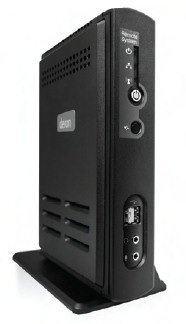
Decades ago, one of the most viable arguments for major enterprises holding onto their "big iron" -- their aging mainframes -- was that they could still provide processing power for thin clients, the smaller and less expensive terminals that didn't need the speed to crunch numbers. Today, in the era of virtualization, the concept of shifting processing power back to the data center has been reborn, especially with the deployment of lighter-weight, single-core processors that only provide the power needed to render results.
With that, a thin-client manufacturer named Devon IT this week announced it's shipping a little PC called the TC5 that frankly isn't much smarter than many smartphones these days...but it doesn't need to be. It's shipping with Intel's single-core Atom N270 processor clocked at 1.66 GHz, which isn't much; it uses Intel's GMA 950 embedded graphics, which also isn't much; and it has Windows XP or Linux on board rather than Windows Vista, and you know the drill there now. So what's its purpose? To serve as a wired or wireless network receiver and to pump data to the screen as fast as possible...and besides gathering user input, that's about it. Its design enables it to run one program -- maybe the only one it ever has to run: a desktop virtualization host.

Up to now, Devon IT had been producing TC2 thin clients using Via single-core processors -- right now, the single-core niches are pretty much Via's last stand, and it's getting big competition from Intel Atom. Pricing for TC5 is not published, and likely depends on quantity purchased -- IBM is partnering with Devon IT for marketing and sales. But to give you an idea of scale: As soon as TC5 was introduced, the company began a one-week markdown sale on the TC2: $159 for the first four units, and $59 for the fifth.
Who's this being marketed to? Right now, Devon IT is making its pitch to hospitals that are growing faster than they can keep up with, to schools that need IT infrastructures and that have limited budgets for putting PCs in every classroom, and -- get this -- to banks and financial institutions that are experiencing more limited growth opportunities in this weak economy.
Subscribe to:
Posts (Atom)